
At first glance, the 1965 cent coin appears ordinary: copper composition, Lincoln on the obverse, and the Memorial on the reverse. Nothing changed greatly, and the coin has been living in the wallets and pockets for a long time.
But yet this date often raises questions. Is there something special about the penny? Is it rare? Does the missing mint mark matter? Can it be valuable? The answers depend on facts, not assumptions. Let’s break them down.
Fact 1: The 1965 Cent Has No Mint Mark
All regular 1965 cents were struck without mint marks. This detail often surprises beginners.
Sometimes, you may see that a 1965 penny no mint mark is treated as something unusual. But actually, it is not: from 1965 through 1967, the U.S. Mint removed mint marks from circulating coins. The goal was to reduce coin hoarding during a nationwide coin shortage.
Because of that policy, every normal 1965 cent lacks a mint mark. The absence of a “D” or other mark does not increase value. It confirms authenticity.
This historical context explains why 1965 cents look different from earlier and later issues. Remember, it does not make them rare.
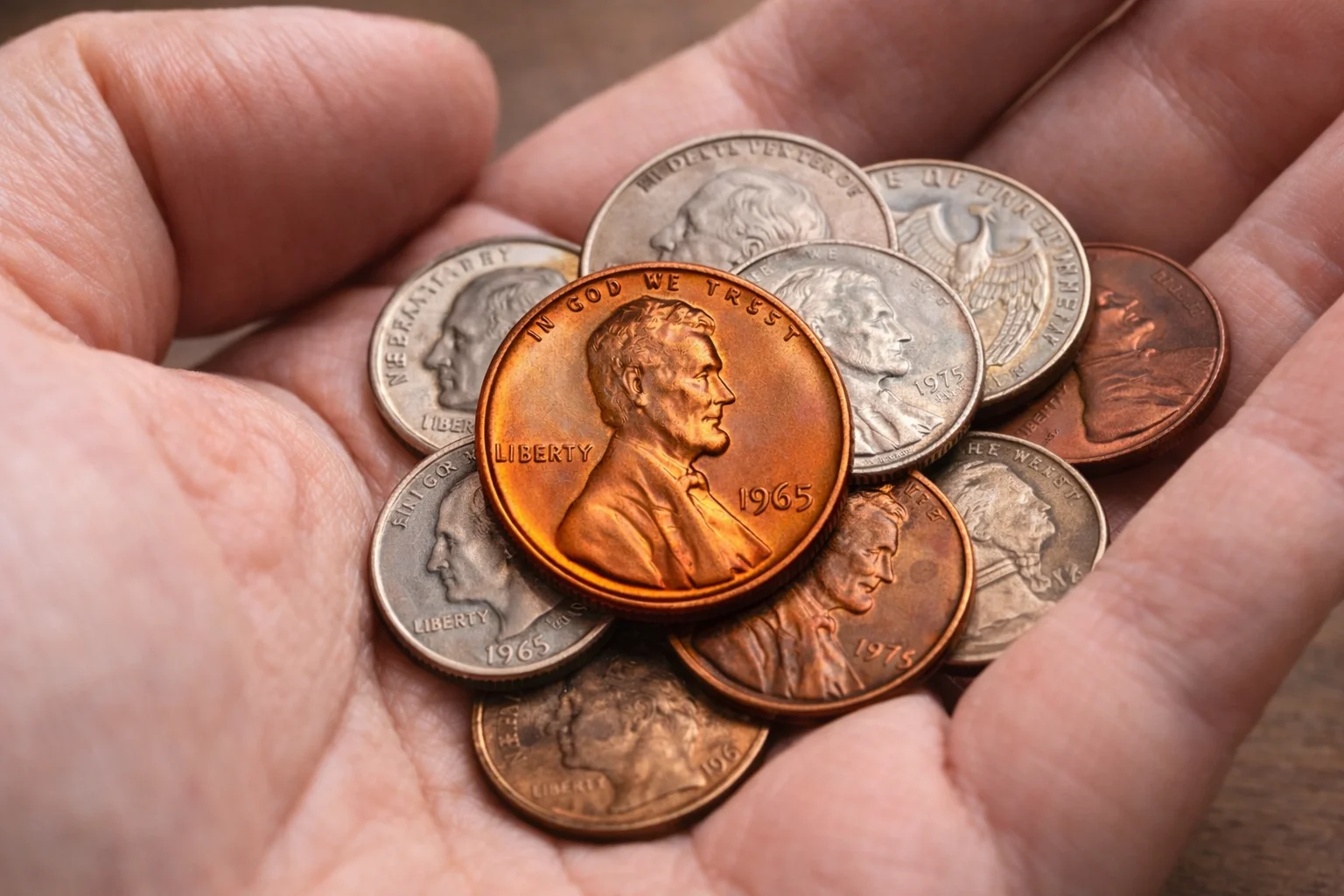
Fact 2: The 1965 Penny Is Still 95% Copper
The composition remained unchanged in 1965. The coin contains 95% copper, and 5% tin, and zinc.
There is no silver content. The metal value does not exceed the face value. Basic specifications can help you to confirm identity:
Feature | Detail |
Year | 1965 |
Mint mark | None |
Composition | 95% copper, 5% tin & zinc |
Weight | 3.11 grams |
Diameter | 19.05 mm |
Edge | Plain |
Obverse | Abraham Lincoln |
Reverse | Lincoln Memorial |
Weight and size help detect damage or alteration. Large deviations usually indicate post-mint issues, not rarity.
By the way, production exceeded one billion pieces. That figure alone explains much of the market behavior. High output means broad survival. Many examples remain in circulation or storage.
Large numbers limit date-based scarcity. The 1965 cent is not a key issue. It does not belong to a low-mintage group. These cents are still available today.
Fact 3: Condition Matters More Than the Year
Date value is limited. Grade value drives price.
Most 1965 cents circulated heavily. Wear appears in predictable areas:
Lincoln’s cheek
Jawline
Hair above the ear
Coat folds
Memorial columns
Circulation creates smooth surfaces. Details flatten gradually. Luster disappears.
Mint State coins look different: surfaces retain original texture; light reflects evenly; high points remain sharp.
Even one grade difference can change the price sharply at higher levels. MS65 and MS66 often trade in very different ranges.
This difference has nothing to do with the year. It reflects preservation.
Fact 4: Color Grades Also Change the Premium
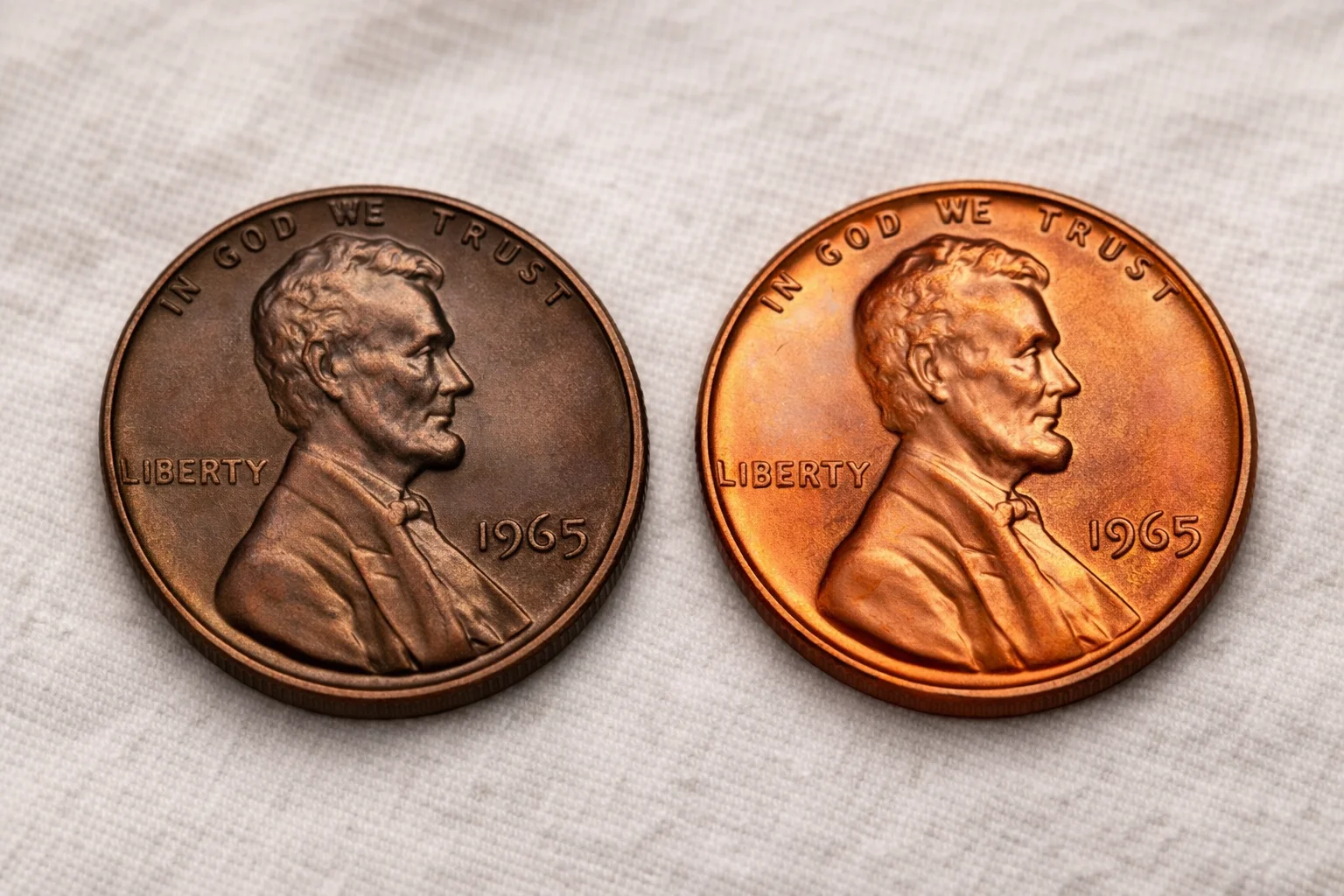
Copper reacts to air. Over time, it darkens. Uncirculated copper cents receive color designations:
Brown (BN) – Fully toned brown surface. No original red remains.
Red Brown (RB) – Mixed red and brown. Partial original color survives.
Red (RD) – Strong original red across most surfaces.
Color affects price in Mint State levels. An MS65 BN may bring modest interest, while the MS65 RD specimen can sell for several times more. Collectors pay for originality. Natural tone signals authenticity.
Artificial alteration harms value. When surfaces are cleaned, the texture changes. The coin may appear brighter, but the surface loses integrity. Experienced buyers notice altered copper quickly. Market interest declines if detected that the coin has been cleaned and the luster is not original.
Fact 5: Some 1965 Pennies Show Real Errors
You probably know that error coins are worth more than their ideal counterparts. True mint errors can raise value significantly. But be sure these are real minting errors, but signs of wear. Some of the errors on 1the 965 penny include:
Error Type | What to Look For | Typical Market Range* |
Dramatic Off-Center | Design shifted noticeably | $30–$75+ |
Double Struck | Two overlapping impressions | $100–$400+ |
Doubled Die Obverse | Clear doubling in date or lettering | $150+ |
Clipped Planchet | Missing curved section of edge | $40–$120+ |
Edge Misalignment (“L” on rim, motto shift) | Letters pushed toward the rim | $20–$100+ |
*Values vary by grade and clarity.
Off-center strikes are among the most visible. The larger the shift, the stronger the premium.
Double strikes show two impressions from separate impacts. Severe overlap draws higher interest.
True doubled dies display separated outlines in letters or numbers. Machine doubling does not qualify.
Clipped planchets show correct metal flow near the clipped edge. Clean cuts without distortion may indicate damage, not error.
A clear production origin is required before assigning value.
Fact 6: High Grades Attract Specialists
Circulated pieces dominate the supply. High-grade examples are fewer. Collectors seek strong luster, minimal marks, and sharp detail.
MS66 and higher pieces gain attention due to scarcity in that condition, not because of the date. The market for top-grade copper cents remains stable. Quality drives demand.
And before assigning a price, confirm details, grade, and check the appearance.
A reliable coin scanner app can assist in checking year, composition, and design details. Coin ID Scanner helps confirm type, provides technical data, and stores coins in a digital collection.
The tool supports organization and verification. But note that the surface quality and preservation still require a professional visual assessment.
Fact 7: Most 1965 Pennies Remain Ordinary
And that is true. Most surviving examples are worn. They are not rare by date. They do not carry melt value premiums. Without a high grade or a verified mint error, they remain common circulation pieces.
Practical Price Overview
Grade | Typical Range |
Circulated | Face value |
AU | $1–$2 |
MS60–63 BN | $3–$8 |
MS64–65 BN | $10–$20 |
MS65 RD | $30–$70 |
MS66 RD | Market dependent |
Upper grades show stronger movement. Small surface differences matter at high levels. Date alone does not create these gaps.
Conclusion
The 1965 Lincoln cent proves again: age does not equal rarity. High production limits date value. Preservation, color, and verified mint errors determine the premium.
Unfortunately, if you are looking for a good investment or a rare piece for your collection, the 1965 Lincoln cent doesn’t belong on the list of coins worth money.
The 1965 cent is primarily a standard circulation issue. Exceptional examples exist, but they are defined by condition and other factors. But this cent is a good starting point to explore numismatic secrets, grading, and value factors. So, find, identify, check, and remember that practice makes perfect.